How to Design a Low-Water Lavender Border for a Sunny Garden
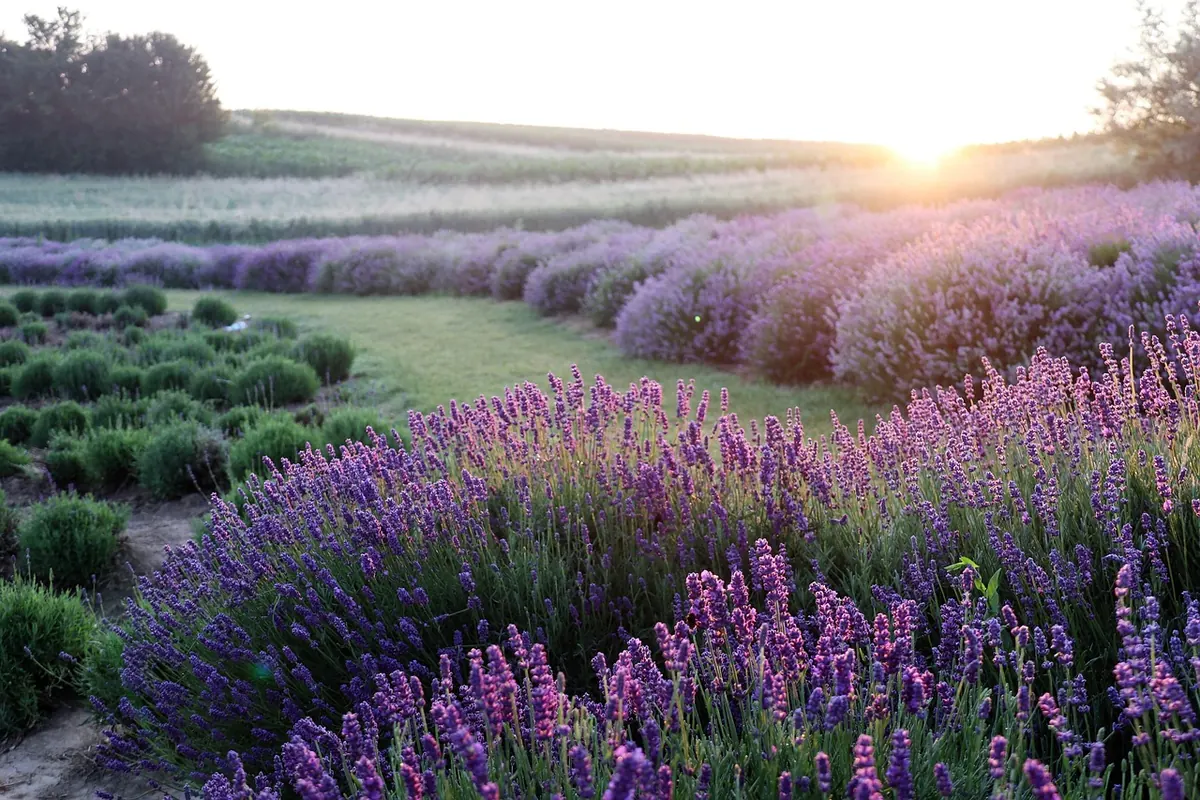
A lavender border should look effortless in July and still make sense in February. That is the real test — not how many plants you can fit into the strip beside the lawn, but whether the planting keeps its shape once the flowers have faded and the ground has baked hard. Get the site right, choose lavenders that can cope with your winters, and build the rest of the border around silver foliage, airy grasses and a small cast of sun-loving perennials that share the same modest appetite for water.
Start with the ground, not the plants
Lavender fails for one reason far more often than any other: wet roots in winter. It is a plant of stony hillsides in the Mediterranean, and it wants a free-draining soil in full sun — six hours or more of direct light, ideally with the worst of the midday heat. Heavy clay that sits soggy from November to March will kill it faster than any drought.
If your soil is anything less than crumbly and free-draining, plant on a slight mound or in a raised bed. Dig in grit or coarse horticultural sand over a wide area rather than tipping a bucketful into each planting hole; the water needs somewhere to go, not just a pocket to sit in. Lavender is also happiest on neutral to alkaline ground, so don't lavish compost on it. Rich soil produces floppy, short-lived plants with plenty of leaf and few flowers.
Before you order anything, walk the site and check three things:
- Sun track: watch where shadows fall at 10am and 4pm in midsummer, not just at noon.
- Drainage: after heavy rain, note any spot where water stands for more than a few hours.
- Prevailing wind: a border that takes the full force of winter gales will need a low shelter or a hardier choice.
Choose lavenders that earn their place
Not all lavender behaves the same way in a border, and mixing types deliberately gives you a longer season.
English lavender (Lavandula angustifolia)
The hardiest and the most fragrant. 'Hidcote' makes a tight grey-green mound around 50cm with deep violet spikes; 'Munstead' is a little looser and earlier, with softer mauve flowers. 'Alba' and 'Rosea' bring white and pink into the scheme without breaking the silver-leafed harmony. These are the lavenders to choose if your winters are cold or your soil is borderline.
Lavandins (Lavandula x intermedia)
Bigger, later and more vigorous — 'Grosso' and 'Provence' will reach 80–90cm and flower for weeks in mid to late summer. They are superb in the middle of a deep border where their long stems can move in the wind, but they are less tolerant of wet cold than English lavender. Plant them where drainage is genuinely good.
French and Spanish lavender (Lavandula stoechas and friends)
Early flowers with those unmistakable winged heads, and a longer season if you trim after each flush. They are the least hardy of the group; in cold gardens treat them as seasonal plants in pots or accept that they may not return. Their loose, informal habit suits gravel gardens and path edges beautifully.
Colour schemes that hold up in full sun
Strong light washes out pale colours, so choose a scheme with enough contrast to survive a bright afternoon.
Silver, blue and violet
The safest and most enduring combination. Lavender against Stachys byzantina, Santolina chamaecyparissus, Artemisia and Ballota pseudodictamnus gives you foliage interest for eight months and flowers for two. Add sea holly (Eryngium) for steel-blue structure and a few clumps of blue fescue at the front.
Purple with hot accents
Violet lavender teamed with warm colours lifts a border out of the ordinary. Achillea 'Terracotta', Coreopsis, Echinacea in orange or red, and the soft haze of Oenothera lindheimeri all thrive in the same dry conditions and flower at the same moment. Keep the hot colours in generous drifts rather than dotted about, or the effect looks nervous.
White and chartreuse
For something cooler, use white lavender with Gaura, white achillea and silver foliage, then thread in acid-green spirea or a bright euphorbia in spring. Deep purple lavender placed beside lime-green leaves is one of the sharpest contrasts in a dry garden and needs no flowers at all to work.
Build the border in layers
Think in three depths and plant each one as a ribbon rather than a row of singles. Repetition is what makes a dry border look designed.
Front edge (30–50cm)
Low lavenders such as 'Munstead', with Santolina clipped into loose cushions, Sedum spectabile for late nectar, and dwarf thrift or dianthus tumbling over the paving. Leave a hand's width of bare ground or gravel between plants and the path.
Middle ground (50–80cm)
Your main lavender planting sits here, interleaved with Nepeta 'Six Hills Giant', Salvia nemorosa 'Caradonna', and Penstemon in purple or pink. These fill the gaps while the lavender establishes and give the border movement in early summer before the lavender takes over.
Back of the border (80cm and up)
Lavandins, Perovskia, tall verbascum, Cistus and airy grasses such as Stipa tenuissima or Molinia. A few taller plants standing above the lavender spikes give the whole scheme a skyline — without one, long borders read as a flat mat.
Layout ideas that work with the shape of a garden
A straight line of lavender along a path is pleasant but static. Curving bands, repeated groups and a clear gravel edge will do far more for the design than adding more species.
For a long border viewed from one side, keep the depth between 1.2 and 1.8 metres — deep enough for three layers, narrow enough to plant and weed from the front. Sweep the front edge in a gentle arc and repeat the same lavender in odd-numbered groups of three, five or seven, spaced so the groups almost touch at maturity. Leave deliberate gaps of gravel between drifts; they give the eye somewhere to rest and let the plants show their individual shapes.
If the border runs beside a terrace or path, plant lavender closest to the paving where you brush against it, and put the taller grasses behind. For a gravel garden, scatter groups across the whole area with winding gaps, and use self-seeders like Allium sphaerocephalon and nigella to stitch the scheme together.
Planting day and the first summer
- Water every pot thoroughly the day before planting.
- Set plants out on the soil, still in their pots, and check the spacing from several angles before you dig.
- Space English lavender 35–45cm apart and lavandins 60–80cm apart; they need air around the crowns.
- Plant slightly deeper than the pot level only if the soil is sandy — on heavier ground keep the crown just proud and mound grit around it.
- Water in well, then mulch with 5–7cm of gravel, keeping it clear of the stems.
Water regularly through the first summer to get roots established, then taper off. After that, a deep soak every few weeks in a long dry spell is plenty; frequent shallow watering encourages weak roots and disease. Trim lightly after flowering in late summer, taking the spent spikes and a couple of centimetres of leafy growth — never cut back into the old, bare wood, which rarely regrows. In cold gardens, leave harder shaping until spring.
Making it work in your own garden
Begin with one generous drift of a single lavender rather than a collection of varieties. Get the drainage right, add gravel, and let the plants knit together for a season before you judge the result. Then add companions one group at a time, matching them to the same conditions: full sun, sharp drainage, and a lean soil. A border built this way settles quickly, asks little of you in August, and still looks deliberate in the middle of winter.
Photo: Buntysmum / Pixabay